Time permitting I participate in the Open Source board layout software project PCB. A recent exchange in the patch tracker brought to light just how scared developers have become of lawyers. Why must we live in fear of these leaches on society?

At issue is one of the developers put a lot of effort in to a enhancement that would 'blink' the difference between two revision of the board layout, to make the changes stand out. To which I raised the potential issue of a user having Photosensitive Epilepsy. This is where certain light patterns can induce seizures in people prone to this problem (it is also being looked at as a 'non-lethal' weapon by the military; watch the movie Looker someday). The end result is that Bert, the developer, decided 'blinking' was unsafe because of the potential for lawyers to appear. How many times have you blinked a LED in that widget you are developing? Now you too can live your life in fear of lawyers. I'll let Bert explain his case, taken from the patch tracker:

See also The Private and Social Costs of Patent Trolls by James E. Bessen, Jennifer Ford, and Michael J. Meurer of Boston University School of Law.
I've been making my case against software patents for years with the example of R++, a mathematical process (that is not patentable), that would allow us to have far safer systems. What is R++ ?:

There is a Federal Register notice, Request for Comments and Notice of Roundtable Events for Partnership for Enhancement of Quality of Software-Related Patents, that the US Patent Office would like to form a partnership with the software community to figure out how to 'enhance' the quality of software patents. To that end, they are looking for comments and there will be two roundtble events sponsored by the USPTO, one in Silicon Valley, Tuesday, February 12th, and one in New York, Wednesday, February 27th. If you plan on attending you must register by Feb 4th. The USPTO plans to make the roundtable events available via Web cast. Web cast information will be available on the USPTO's Internet Web site before the events. Grok Law has more on the issue, and a copy of the relevant Federal Register pages may be found at IP Watchdog.
Leave a comment if you think you can make it to one of these events, and give us a first hand report, please.

At issue is one of the developers put a lot of effort in to a enhancement that would 'blink' the difference between two revision of the board layout, to make the changes stand out. To which I raised the potential issue of a user having Photosensitive Epilepsy. This is where certain light patterns can induce seizures in people prone to this problem (it is also being looked at as a 'non-lethal' weapon by the military; watch the movie Looker someday). The end result is that Bert, the developer, decided 'blinking' was unsafe because of the potential for lawyers to appear. How many times have you blinked a LED in that widget you are developing? Now you too can live your life in fear of lawyers. I'll let Bert explain his case, taken from the patch tracker:
Hi Bob,This leads us to the issue of software patents and patent trolls. Lindsay Blakely, on the staff at Inc.com, recently wrote the piece How Much It Costs to Fight a Patent Troll, describing what happens to us 'little guys' that don't have teams of leaches, sorry, lawyers, on staff.
Thanks for the warning.
The default delay value is 50, which means 50 centi-seconds, which equals to toggling every 0.5 seconds, which gives 2 Hz.
On my laptop it takes even longer than 0.5 seconds for the default value to toggle (twice a second).
The above UK site mentions:
[quote]
Most people with photosensitive epilepsy are sensitive to 16-25 Hz. Some people may be sensitive to rates as low as 3 Hz and as high as 60 Hz.
[quote]
Nevertheless the user can still inflict some damage upon him/herself by changing the delay parameter, or tuning/modifying the software, their computer, or whatever.
My gut feeling (legal adviser) says it's better to withdraw any patch for any blinking whatsoever, due to the way the US legal system regarding injuries and lawsuits functions.
Bear in mind that the upstream pcb repository resides on US soil.
3 Hz is just to close to 2 Hz for me to feel comfortable.
Put in other words: risk = probability * effect --> I take zero chance and rather have no effect.
See also The Private and Social Costs of Patent Trolls by James E. Bessen, Jennifer Ford, and Michael J. Meurer of Boston University School of Law.
I've been making my case against software patents for years with the example of R++, a mathematical process (that is not patentable), that would allow us to have far safer systems. What is R++ ?:
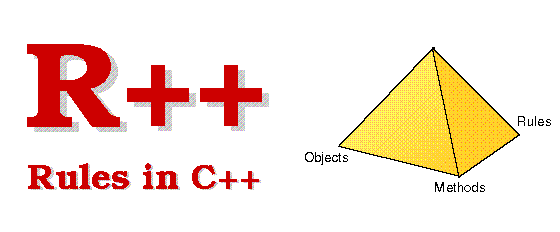
R++ is ''rules in C++''. R++ is an extension to C++ that bridges the gap between object-oriented programming and data-driven (rule-based) programming. Programs written in R++ have all the facilities of C++ plus a new programming construct: a rule. A rule is like an ''IF-THEN'' statement, but it sits apart from the procedural code and is triggered automatically upon changes to the data that it monitors. In effect, rules monitor object memory and react when their ''IF'' clause becomes true.The problem is that through mega mergers, sellouts, and buyouts, no one can actually figure out who owns what. Lucent has a patent on the technology in R++ but AT&T owns the production version of the software. Commercial use of R++ is a bit more tricky. Neither Bell Labs Research nor AT&T Labs Research are in the business of distributing research generated software for commercial use. I was able to get a principal at Lucent on board with open-sourcing R++. However any contact at all with AT&T got a me a referral to the legal department voice mail. Despite repeated attempts at email and phone messages, I've never been contacted by anyone from AT&T. Is it any wonder they are so hated by most (cell-)phone users?
What are rules useful for?
- Applications can use rules to help maintain model integrity by enforcing invariants and detecting constraint violations in the model.
- Applications that monitor a physical system (such as a telephone switching system) can use rules to detect and react to critical states.
- Applications that are primarily reactive (such as an elevator controller) can use rules to express state transitions.
- Applications that apply engineering guidelines (such as in equipment configuration) or business policies (such as in loan analysis) can use rules to apply the guidelines/policies when each situation arises.
- As a software engineering aid, rules can be used as a kind of non-procedural exception mechanism for detecting and handling illegal states.
There is a Federal Register notice, Request for Comments and Notice of Roundtable Events for Partnership for Enhancement of Quality of Software-Related Patents, that the US Patent Office would like to form a partnership with the software community to figure out how to 'enhance' the quality of software patents. To that end, they are looking for comments and there will be two roundtble events sponsored by the USPTO, one in Silicon Valley, Tuesday, February 12th, and one in New York, Wednesday, February 27th. If you plan on attending you must register by Feb 4th. The USPTO plans to make the roundtable events available via Web cast. Web cast information will be available on the USPTO's Internet Web site before the events. Grok Law has more on the issue, and a copy of the relevant Federal Register pages may be found at IP Watchdog.
Leave a comment if you think you can make it to one of these events, and give us a first hand report, please.


 Posts
Posts


